Fiber Laser Marking Machines: The Ultimate Guide to Precision, Permanent Marking
If you’ve ever wondered how manufacturers stamp serial numbers on metal parts, etch logos onto phone cases, or add tamper-proof codes to industrial components, chances are a fiber laser marking machine was behind it. This technology has quietly become one of the most important tools in modern manufacturing — and it’s easy to see why once you understand what it actually does.
What Is a Fiber Laser Marking Machine?
A fiber laser marking machine uses a high-intensity laser beam, generated through a fiber optic cable doped with rare-earth elements (typically ytterbium), to create permanent marks on a wide range of materials. Unlike ink-based printing or mechanical engraving, fiber laser marking doesn’t rely on consumables that run out or tools that wear down. Instead, it uses focused light energy to alter the surface of a material — through processes like annealing, engraving, or ablation — leaving behind a mark that can last the lifetime of the product.
These machines are prized in industries like automotive, aerospace, medical devices, electronics, and jewelry for one simple reason: they combine speed, precision, and permanence in a way few other technologies can match.
How Does It Work?
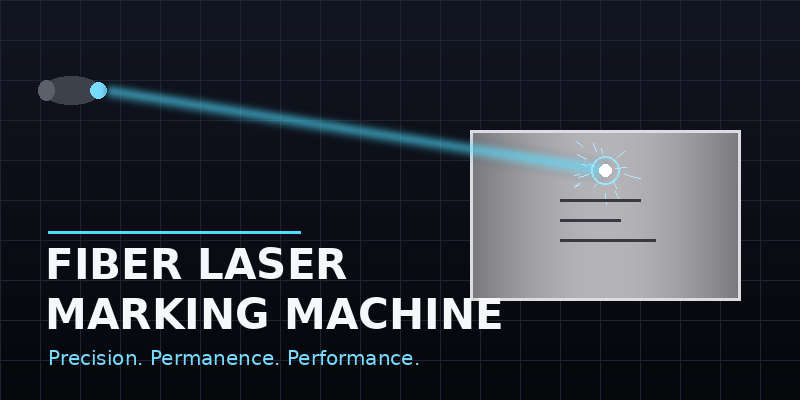
At the core of every fiber laser marking machine is a laser source that generates a beam of concentrated light. This beam travels through a flexible fiber optic cable rather than open-air mirrors (as in older CO2 or crystal laser systems), which makes the machine more compact, energy-efficient, and low-maintenance.
The beam is then directed by a galvanometer scanning system — essentially a set of fast-moving mirrors — onto the material’s surface. Depending on the settings, the laser can:
- Anneal metal surfaces, causing a color change through oxidation without removing material (common for stainless steel)
- Engrave by vaporizing a thin layer of material to create a visible, tactile mark
- Etch by melting the surface slightly to raise or alter its texture
- Ablate coatings or layers to reveal a contrasting material underneath
The entire process is controlled by software, where users design the text, logo, barcode, or pattern they want marked, then let the machine execute it with micron-level accuracy.
Why Businesses Are Switching to Fiber Laser Marking
1. Unmatched Precision
Fiber lasers can mark incredibly fine details — think tiny QR codes, intricate logos, or micro-text — with consistent accuracy across thousands of parts.
2. Permanent and Tamper-Resistant
Because the mark is embedded into the material itself rather than sitting on top of it, fiber laser marks resist fading, scratching, and chemical exposure. This makes them ideal for traceability, compliance labeling, and anti-counterfeiting.
3. Fast and Efficient
Marking speeds are significantly faster than traditional engraving or printing methods, which translates directly into higher production throughput.
4. Low Maintenance, Low Cost Over Time
With no ink, no chemicals, and a laser source that can last 100,000+ hours, the total cost of ownership is remarkably low compared to alternative marking methods.
5. Versatile Across Materials
Fiber lasers work exceptionally well on metals (stainless steel, aluminum, titanium, brass) and also handle certain plastics, coated surfaces, and even some ceramics.
Common Applications
- Automotive: VIN numbers, part traceability codes, branding on components
- Medical Devices: UDI (Unique Device Identification) compliance marking on surgical instruments and implants
- Electronics: Serial numbers, date codes, and logos on circuit boards and casings
- Jewelry: Fine detailing, engraving names, or hallmark stamps
- Industrial Tools: Asset tags, barcodes, and safety information
Choosing the Right Fiber Laser Marking Machine
If you’re considering investing in one, a few factors matter most:
- Laser Power (Wattage): Lower power (20-30W) suits fine detail work on softer materials; higher power (50-100W) handles deeper engraving and harder metals.
- Marking Area and Speed: Match the machine’s working field and speed to your production volume.
- Software Compatibility: Look for intuitive design software that supports common file formats and integrates with your production line.
- Build Quality and Support: Since this is a long-term investment, prioritize manufacturers with strong after-sales support and readily available replacement parts.
Final Thoughts
Fiber laser marking machines represent a rare combination of precision engineering and practical reliability. Whether you’re a small workshop adding branding to custom products or a large-scale manufacturer needing traceable, compliant part identification, this technology delivers a level of consistency and durability that’s hard to beat.
As industries continue to demand higher traceability standards and tighter tolerances, fiber laser marking isn’t just a nice-to-have — it’s becoming an industry standard.
Tags: Fiber laser marking machine suppliers, Fiber laser marking machine Manufacturers