Electromagnetic Flow Meter and Flow Meter: Complete Guide for Industrial Applications
Flow measurement plays a vital role in industrial processes where accurate monitoring of liquids, gases, and slurries is essential for operational efficiency. Among the various flow measuring devices available today, the Electromagnetic Flow Meter has become one of the most reliable and widely used technologies in industries such as water treatment, pharmaceuticals, chemicals, food processing, and wastewater management.
This blog explores the concept of flow meters, the working principle of electromagnetic flow meters, their advantages, applications, and why industries prefer them for precise flow measurement.
What is a Flow Meter?
A Flow Meter is an instrument used to measure the quantity, speed, or volume of liquid or gas flowing through a pipeline. These devices help industries monitor fluid movement, maintain process efficiency, reduce wastage, and ensure product quality.
Flow meters are commonly used in:
- Water treatment plants
- Oil & gas industries
- Chemical processing
- Food & beverage manufacturing
- Pharmaceutical industries
- HVAC systems
- Irrigation systems
Flow meters are available in several types depending on the application and fluid characteristics.
Types of Flow Meters
There are different types of flow meters designed for various industrial applications:
- Electromagnetic Flow Meter
Measures conductive liquid flow using electromagnetic principles.
- Ultrasonic Flow Meter
Uses sound waves to determine flow velocity.
- Turbine Flow Meter
Measures flow through the rotation of a turbine.
- Differential Pressure Flow Meter
Calculates flow using pressure differences.
- Vortex Flow Meter
Measures flow using vortices generated by fluid movement.
- Positive Displacement Flow Meter
Measures exact fluid volume passing through the meter.
Among these, electromagnetic flow meters are highly preferred for conductive liquids due to their accuracy and low maintenance.
What is an Electromagnetic Flow Meter?
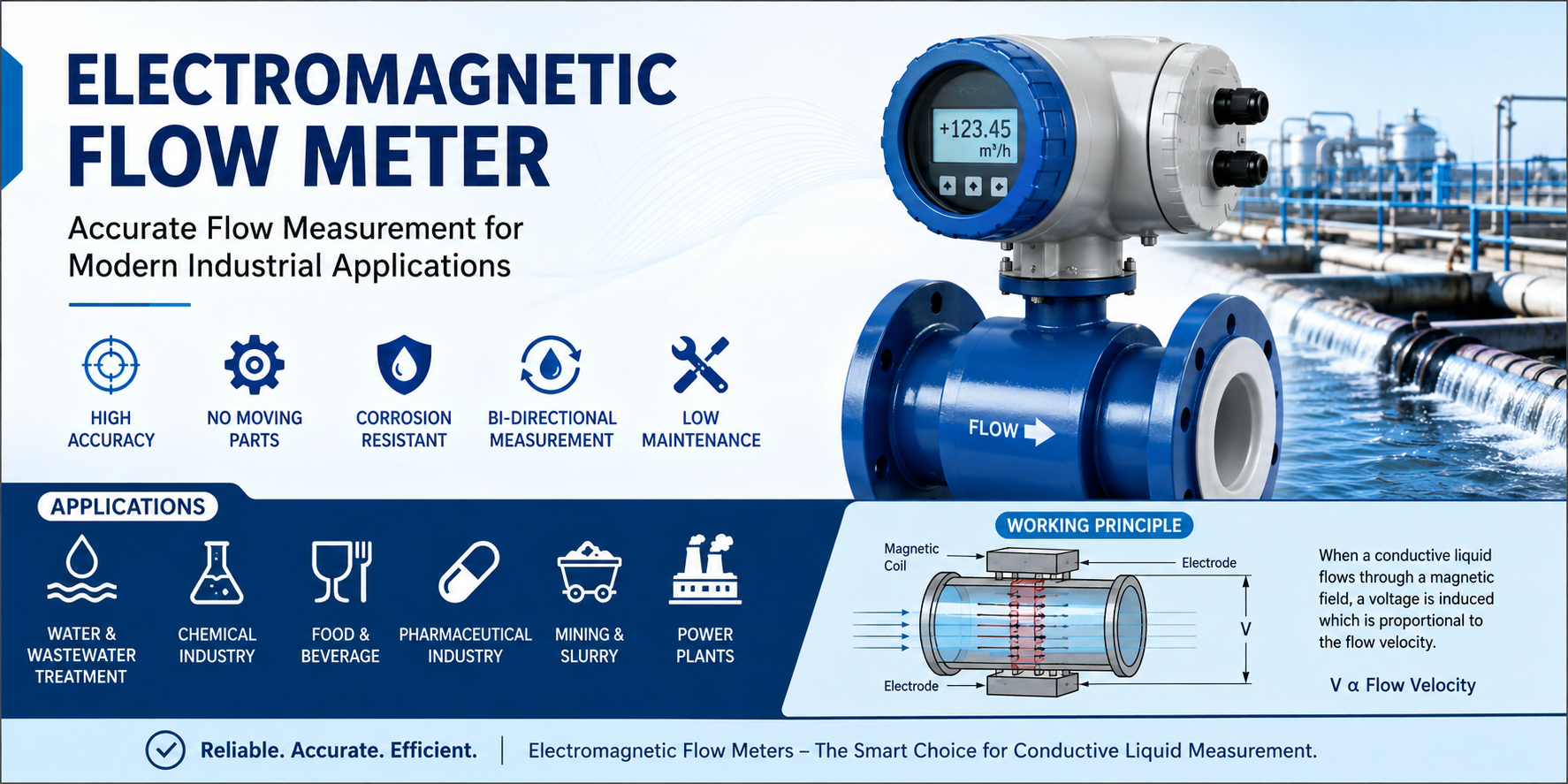
An Electromagnetic Flow Meter, also known as a Mag Flow Meter, is a device used to measure the flow rate of conductive liquids using Faraday’s Law of Electromagnetic Induction.
It is ideal for measuring:
- Water
- Wastewater
- Slurries
- Chemicals
- Acids
- Food-grade liquids
Unlike mechanical flow meters, electromagnetic flow meters have no moving parts, making them highly durable and maintenance-free.
Working Principle of Electromagnetic Flow Meter
The electromagnetic flow meter works on Faraday’s Law, which states that when a conductive liquid flows through a magnetic field, it generates voltage proportional to the flow velocity.
Basic Working Process:
- A magnetic field is generated inside the flow tube.
- Conductive liquid passes through the magnetic field.
- Electrodes detect the generated voltage.
- The transmitter converts voltage into flow rate readings.
The measured voltage is directly proportional to the liquid velocity.
This technology ensures highly accurate and reliable flow measurement.
Key Components of an Electromagnetic Flow Meter
- Flow Tube
Carries the liquid through the meter.
- Electrodes
Sense the voltage generated by fluid movement.
- Magnetic Coils
Create the magnetic field required for measurement.
- Transmitter
Processes signals and displays flow readings.
- Lining Material
Protects the meter from corrosion and abrasion.
Advantages of Electromagnetic Flow Meter
High Accuracy
Provides precise flow measurement even in challenging conditions.
No Moving Parts
Reduces wear and tear, leading to low maintenance.
Suitable for Dirty Liquids
Can measure sludge, slurry, and wastewater effectively.
Pressure Loss-Free Operation
The unobstructed flow path minimizes pressure drop.
Long Service Life
Designed for continuous industrial operation.
Corrosion Resistance
Suitable for aggressive chemicals and acidic liquids.
Bi-Directional Measurement
Measures flow in both directions.
Applications of Electromagnetic Flow Meters
Electromagnetic flow meters are widely used across industries:
Water & Wastewater Treatment
Monitoring water distribution and sewage systems.
Chemical Industry
Measuring corrosive chemical flow accurately.
Food & Beverage Industry
Used for hygienic liquid processing applications.
Pharmaceutical Industry
Ensures precise liquid dosing and process control.
Mining Industry
Measures slurry and abrasive liquids.
Power Plants
Used in cooling water and process systems.
Limitations of Electromagnetic Flow Meter
Although highly efficient, electromagnetic flow meters have some limitations:
- Only suitable for conductive liquids
- Cannot measure hydrocarbons or gases
- Requires proper grounding
- Initial installation cost may be higher
However, their long-term performance often outweighs these limitations.
How to Choose the Right Flow Meter
Selecting the right flow meter depends on several factors:
Fluid Type
Liquid, gas, slurry, or steam.
Conductivity
Electromagnetic flow meters require conductive fluids.
Pipe Size
Meter size should match pipeline dimensions.
Temperature & Pressure
Choose materials suitable for process conditions.
Accuracy Requirement
Industrial applications may require high precision.
Maintenance Needs
Low-maintenance meters reduce operational costs.
Why Industries Prefer Electromagnetic Flow Meters
Industries prefer electromagnetic flow meters because they offer:
- Excellent accuracy
- Stable performance
- Long operational life
- Minimal maintenance
- Reliable measurement for difficult fluids
Their ability to handle corrosive and dirty liquids makes them a top choice for industrial flow measurement.
Conclusion
Flow meters are essential instruments for industrial process monitoring and efficiency. Among all types, Electromagnetic Flow Meters stand out due to their accuracy, reliability, and maintenance-free operation.
Whether used in wastewater treatment, chemical processing, or food manufacturing, electromagnetic flow meters provide dependable flow measurement for conductive liquids. Choosing the right flow meter improves productivity, reduces operational costs, and ensures smooth industrial performance.
If your industry requires accurate and durable flow measurement solutions, electromagnetic flow meters are an excellent investment for long-term efficiency and process control.